Launch offer · until midnight: —
For therapists and counselors · Printable PDF
The neuroscience you actually use in session, one concept per page.

NeuroCards for Therapists — 60 illustrated cards: amygdala, stress axis, dopamine, traumatic memory, sleep, rumination… Each one comes with the diagram, the ①-④ mechanism and the sentence you can use to explain it to your client.

Brain basicsNeurotransmittersEmotion and stressMemorySleep and motivationIn session
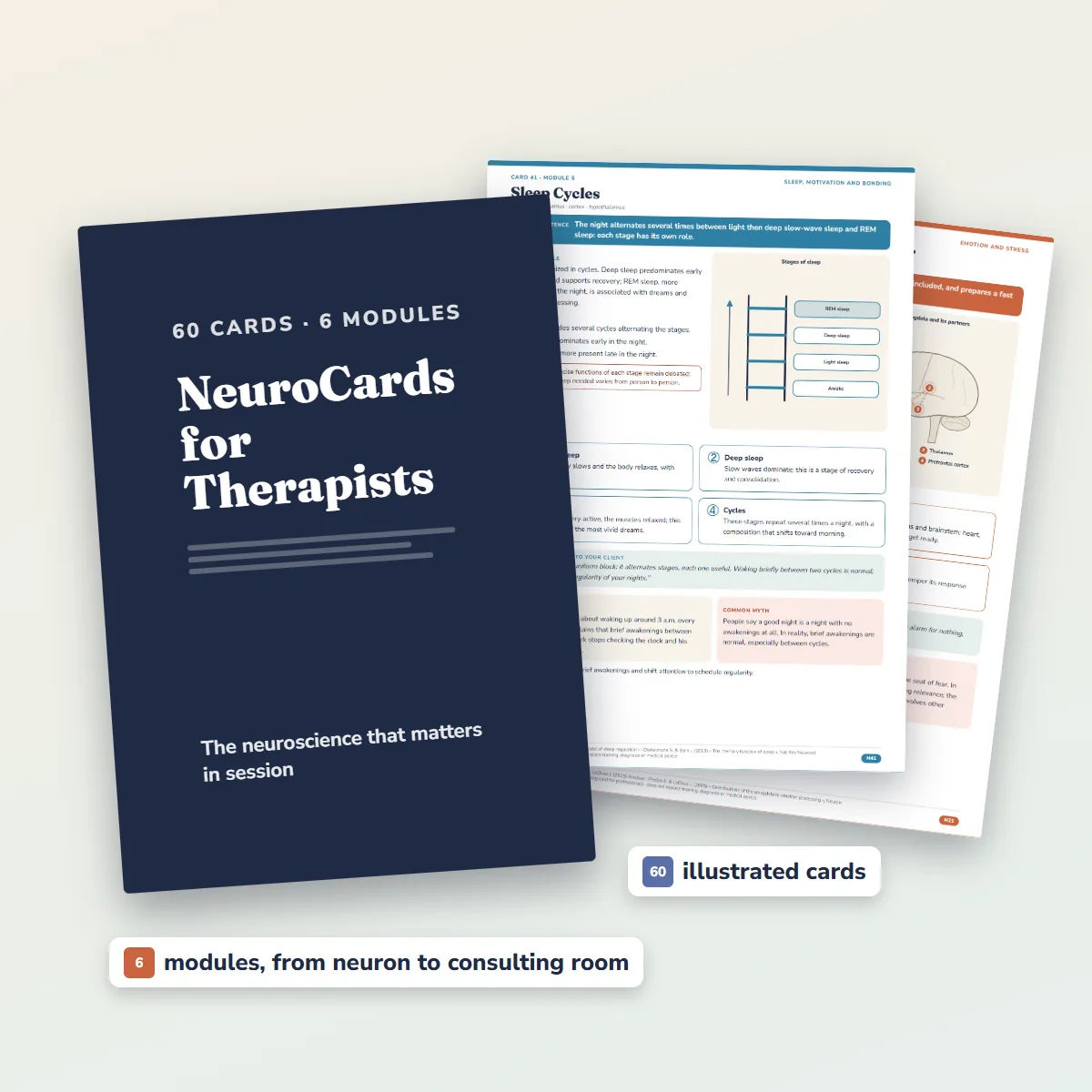
NeuroCards for Therapists: the cover and two cards
Instead of $63 $27−57%
I want the NeuroCards60 cards + a free gift — $27
🔒 Secure payment⬇️ Instant access by email↩︎ 30-day guarantee
Sound familiar?

Your client asks “why?” You need to explain it simply.

Neuroscience textbooks run to hundreds of pages. In session, you have two minutes and a worried person sitting across from you.

😰

“Why is my heart pounding when there’s no danger?” You know it’s the brain’s alarm system, but how do you say it without jargon?

🧠

A client brings up a “chemical imbalance” or the “reptilian brain”: you want to correct the misconception without losing them.

📚

Your neuroscience coursework is dated: serotonin, cortisol, reconsolidation… what’s established and what no longer is isn’t always clear.

✍️

You sketch a freehand brain in the corner of a page to show the amygdala.

The expertise isn’t missing. What’s missing is the clear page, with the right diagram, at the right moment.

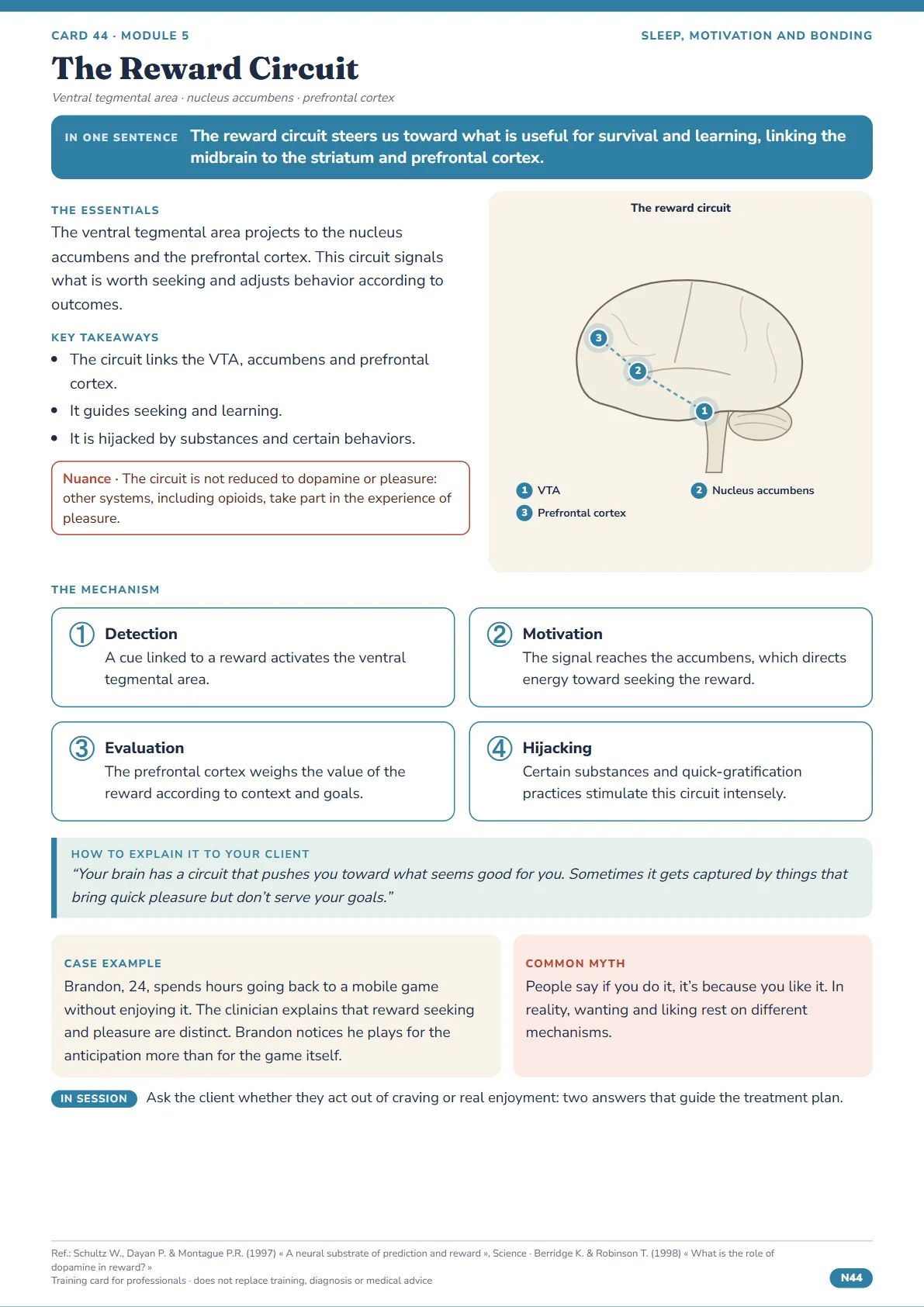
Card 44: the reward circuit
The solution

One concept = one page. One diagram to show.

NeuroCards for Therapists brings together the 60 neuroscience concepts you really need in session, from the neuron to clinical applications, grouped into 6 modules.

Every card has its own diagram (brain regions numbered and linked like a circuit), the mechanism in 4 steps, the ready-to-use sentence for your client, a case example and the common myth to correct.

Plus a “Nuance” box on every page: what’s established and what’s still debated. So you can talk about the brain without saying things off the cuff.

Inside a card

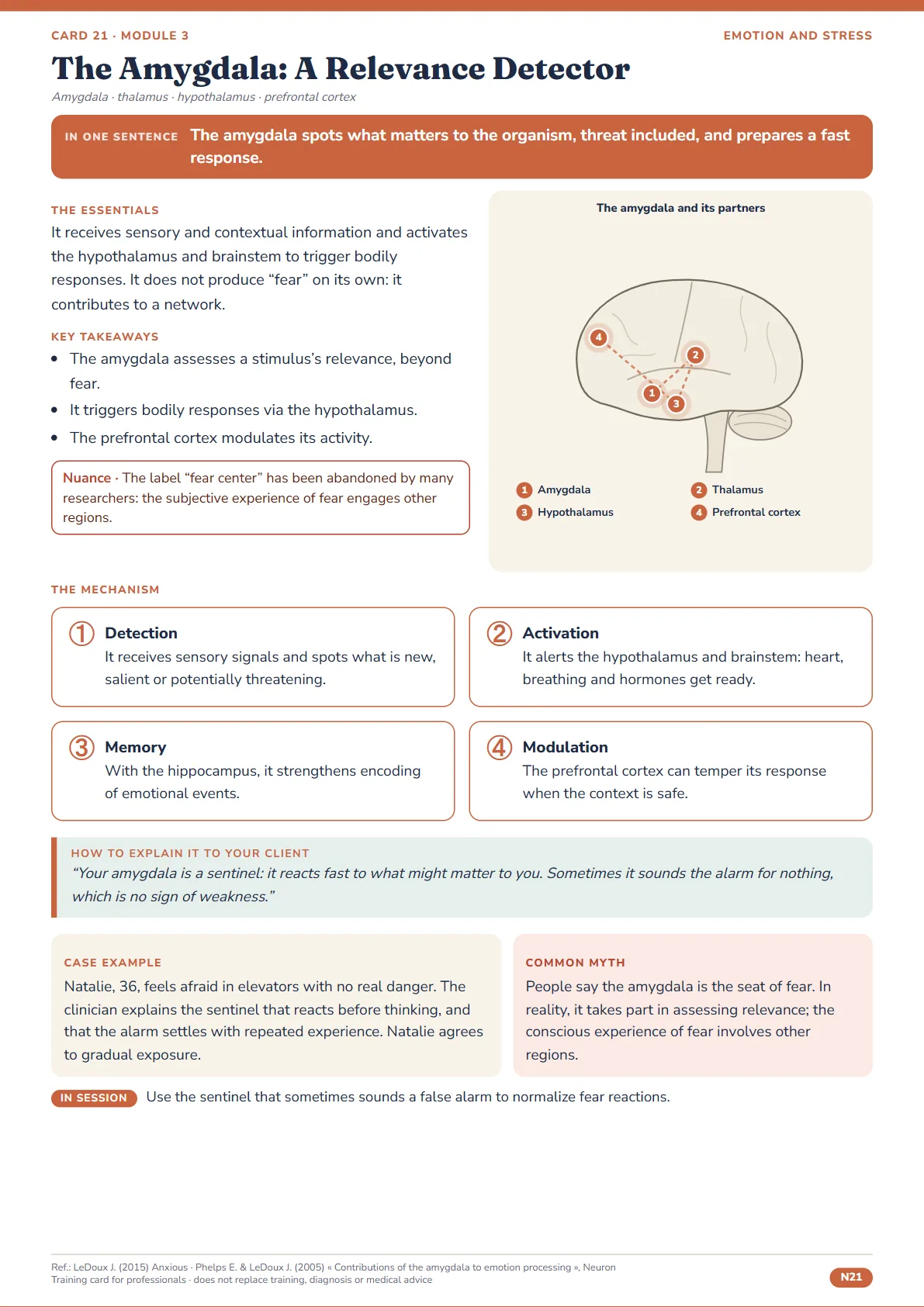
The amygdala, exactly as it appears in the guide

Card 21, on a single page.

Card 21: the amygdala, relevance detector
  1. In one sentence, the essentials and the nuanceThe concept without jargon and what’s still debated.
  2. The diagramThe brain regions involved, ready to show your client.
  3. The ①-④ mechanism and the sentence for your clientHow it works and how to say it in session.
  4. The case example and the common mythA real-world session scenario and the myth to correct.
60 cards · 6 modules

From the neuron to your next session

Every card fits on one page.

Module 1Brain basics10 cards
  • Neuron, synapse, neuroplasticity
  • Prefrontal cortex, autonomic nervous system
  • Executive functions, large-scale networks
Module 2Neurotransmitters and hormones10 cards
  • Dopamine, serotonin, norepinephrine
  • GABA, glutamate, oxytocin
  • Cortisol, endocannabinoids
Module 3Emotion and stress10 cards
  • Amygdala, fear pathways, stress axis
  • Emotion regulation, interoception
  • Window of tolerance, polyvagal theory (and its limits)
Module 4Memory and learning10 cards
  • Hippocampus, consolidation, reconsolidation
  • Fear conditioning and extinction
  • Traumatic memory, habits, attention
Module 5Sleep, motivation and bonding10 cards
  • Sleep and emotions, circadian clock
  • Reward, addiction, impulsivity
  • Attachment, empathy, rumination
Module 6Neuroscience in the consulting room10 cards
  • Depression, panic, PTSD, OCD, ADHD
  • What psychotherapy changes in the brain
  • Explaining the brain to your client, neuromyths
60illustrated cards
60diagrams
6modules
70letter-size pages
I want the NeuroCards
For psychoeducation

The sentence you use to explain it, already written.

Every card has a “How to explain it to your client” box: two simple sentences, jargon-free, that you can adapt to your own style.

You put the card on the table, point to the diagram, and your client understands what’s happening in their body and mind.

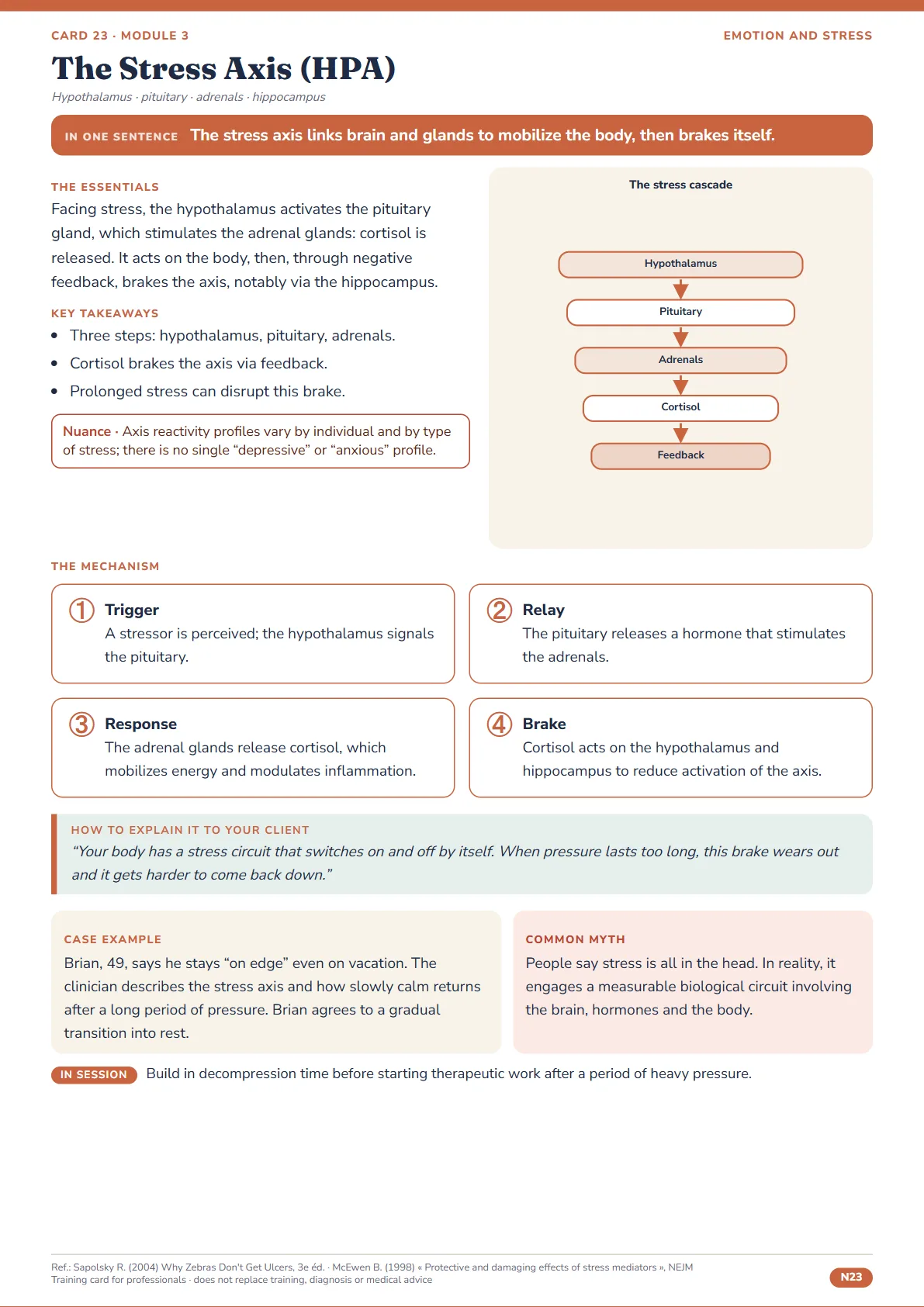
Card 23: the stress axis
Preview

A few pages, for real

Six of the 70 pages, just as you’ll print them.

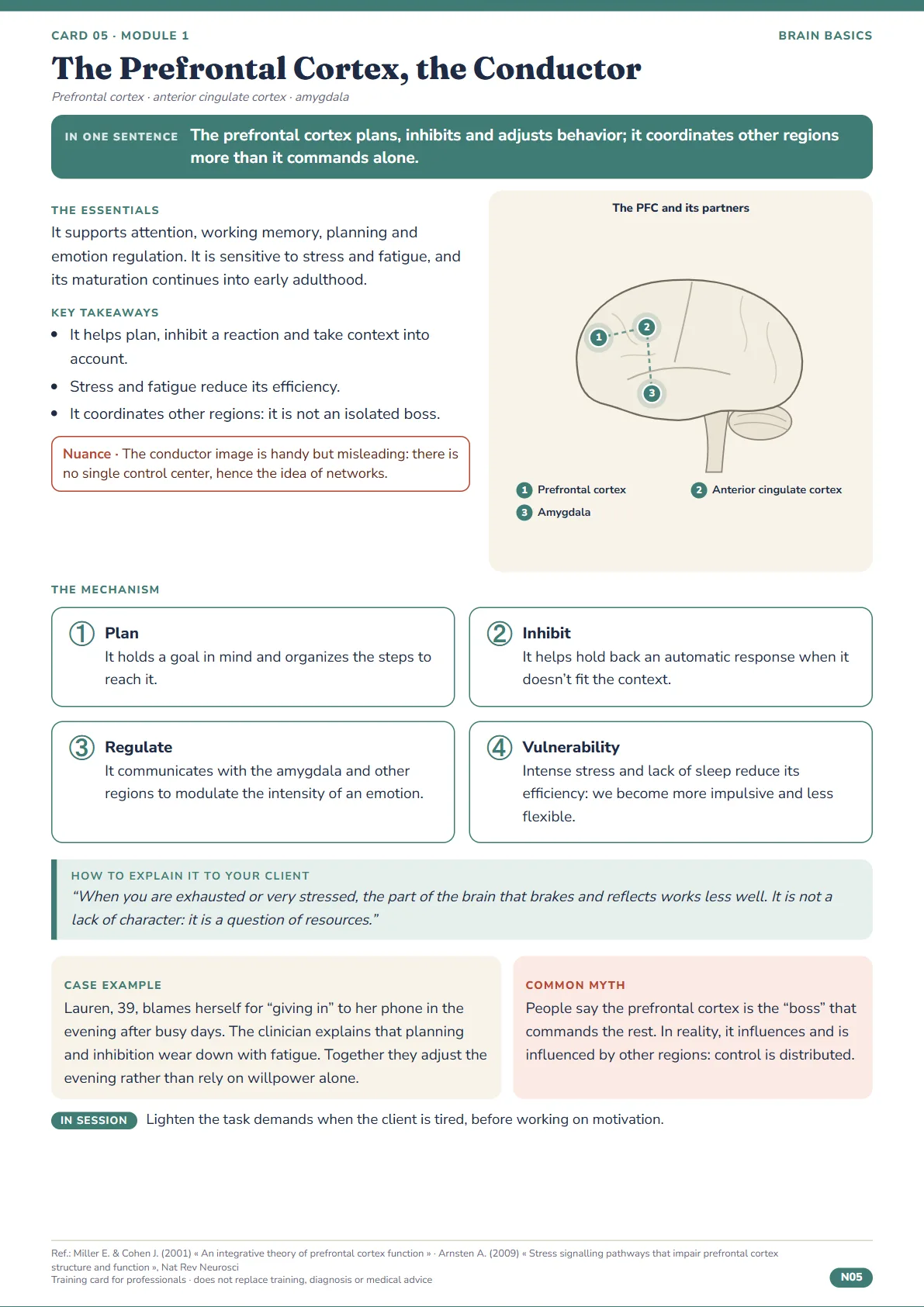
N05 The prefrontal cortex
The prefrontal cortexN05 · Basics
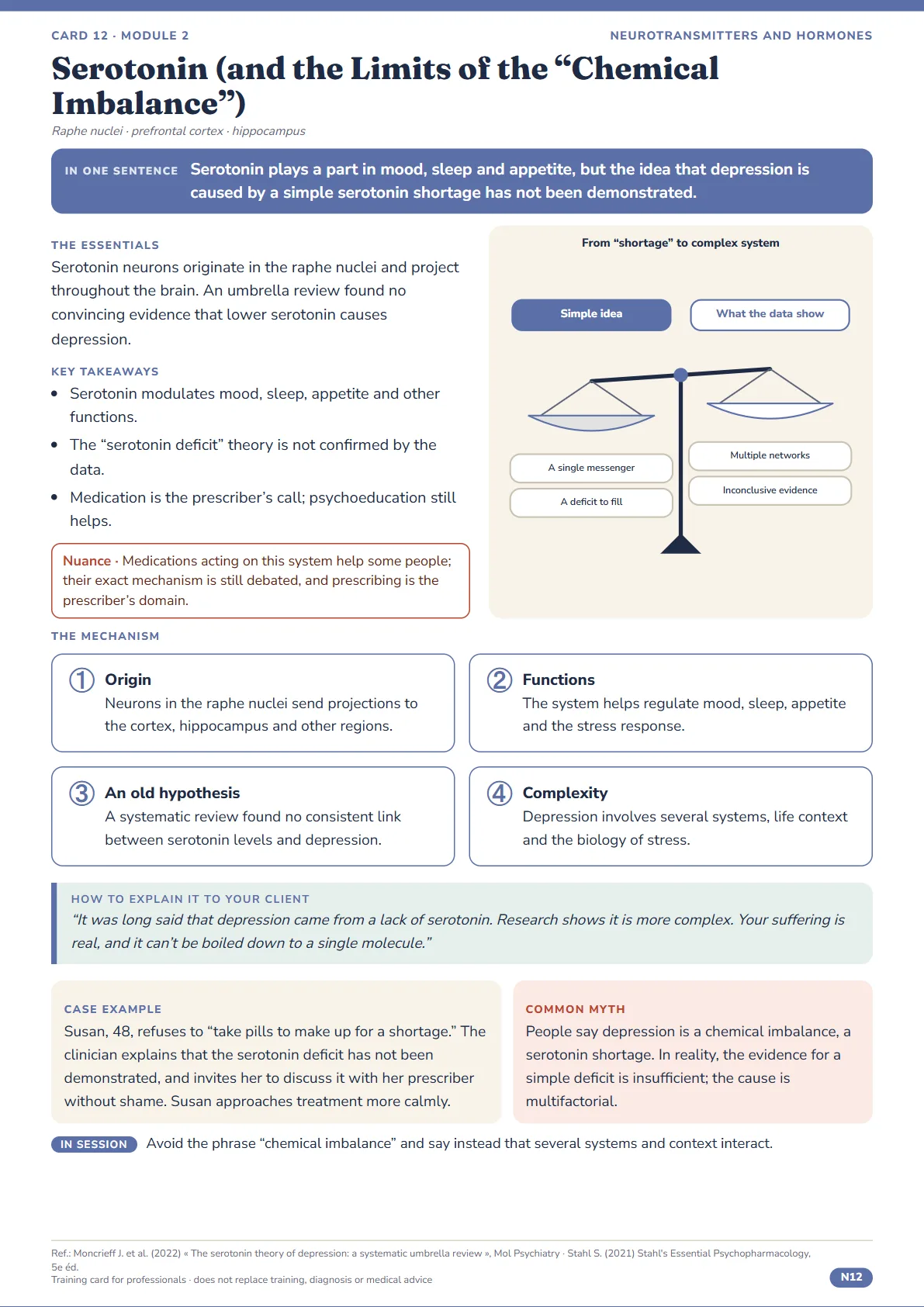
N12 Serotonin
SerotoninN12 · Neurotransmitters
N21 The amygdala
The amygdalaN21 · Emotion and stress
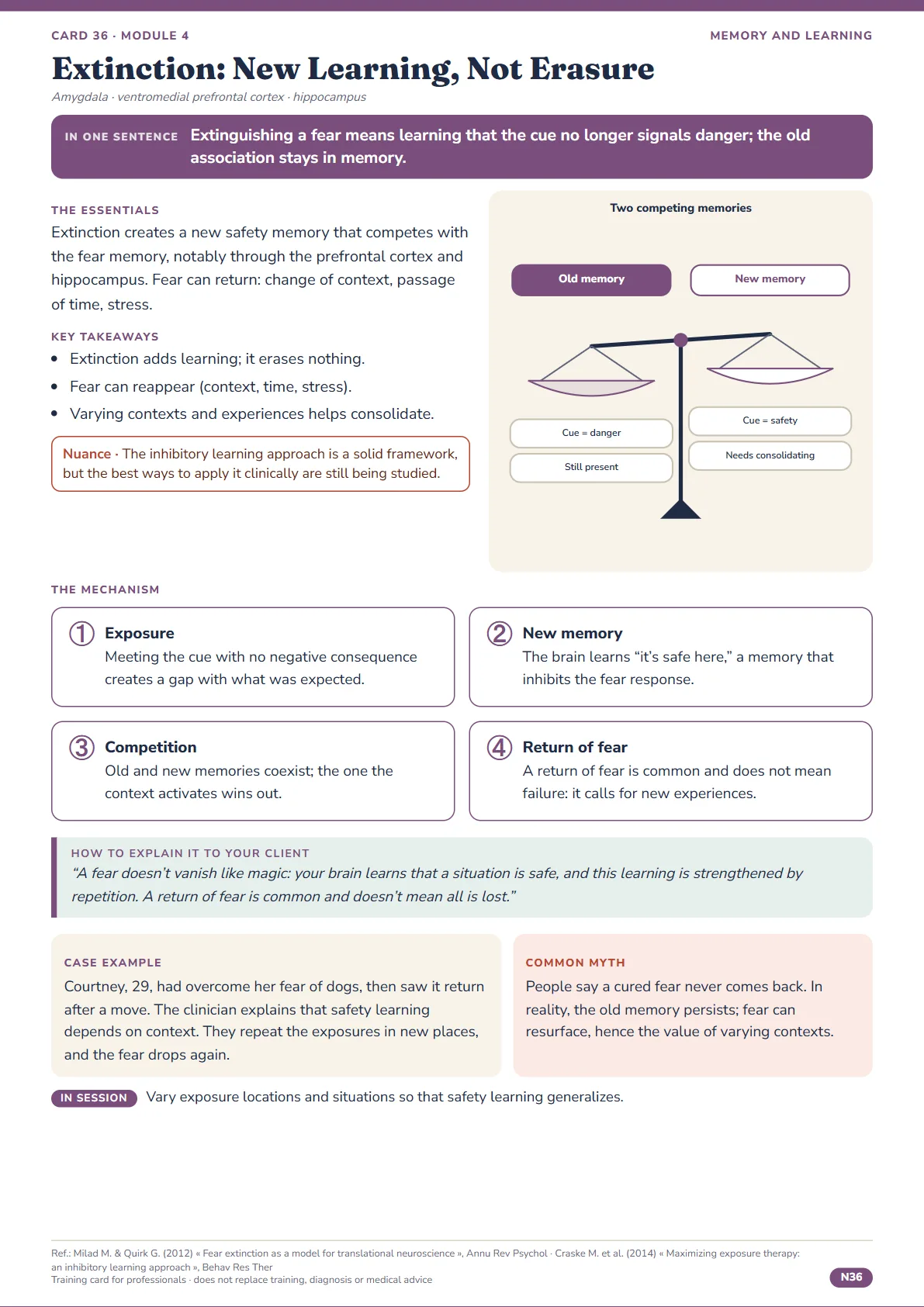
N36 Extinction
Fear extinctionN36 · Memory
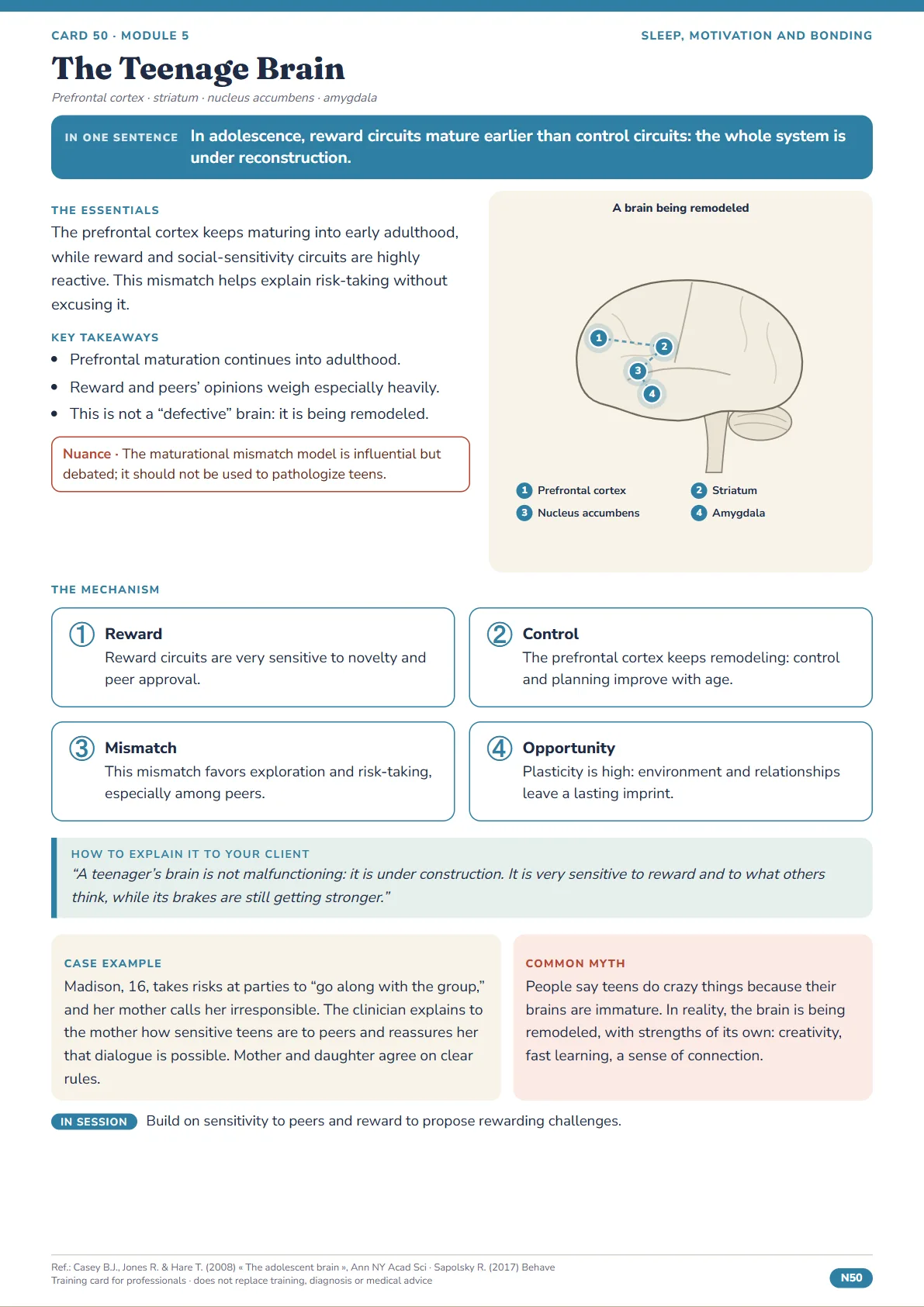
N50 The teenage brain
The teenage brainN50 · Motivation and bonding
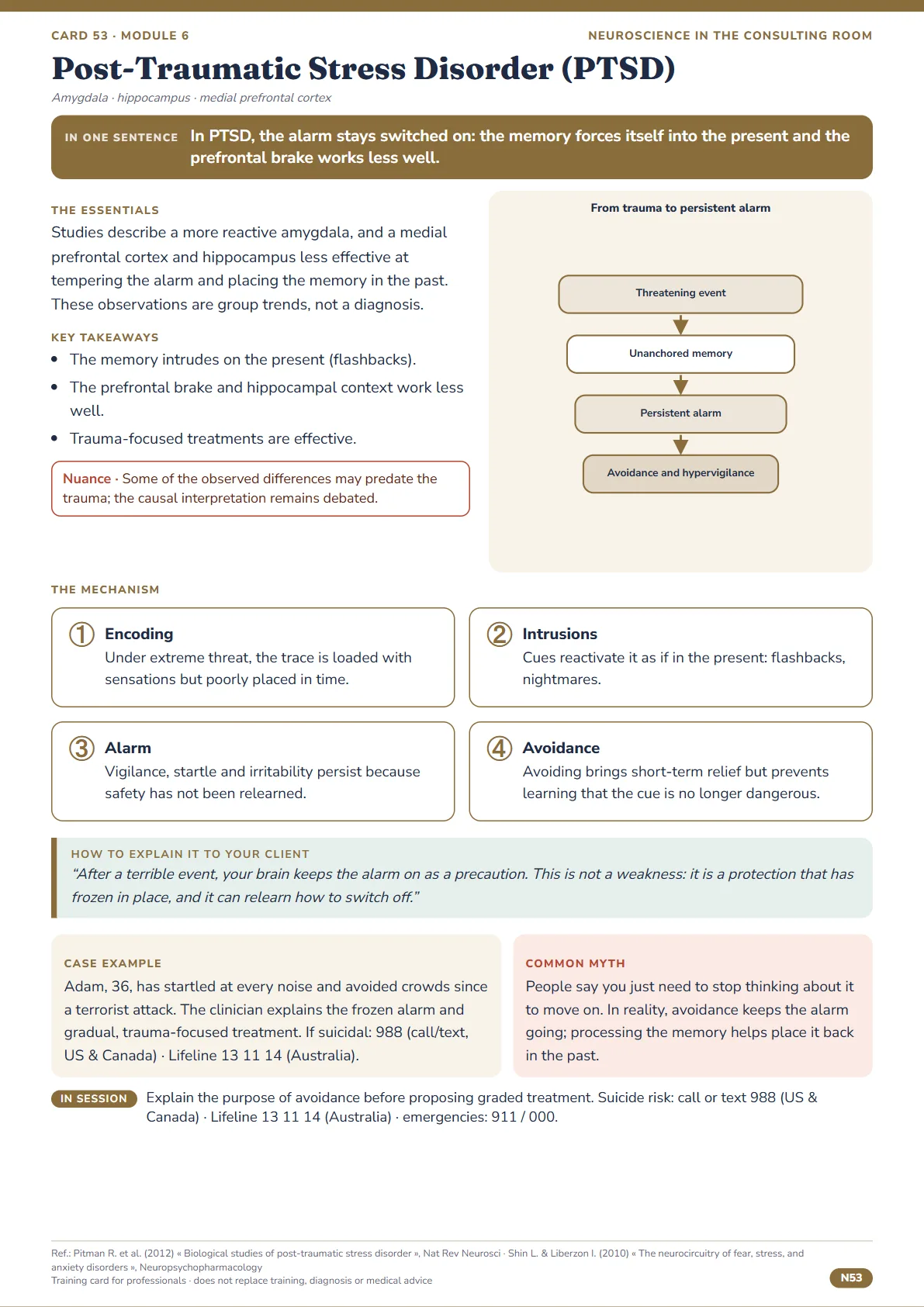
N53 Post-traumatic stress disorder
Post-traumatic stressN53 · In session
Who is it for?

Is it for you?

It’s for you if…

  • You’re a psychologist, therapist (LPC, LCSW, LMFT), counselor or psychology student.
  • You want to explain your clients’ anxiety, stress or trauma in a way they can understand.
  • You want to update your knowledge without rereading an entire textbook.
  • You want to know what’s established and what belongs with the neuromyths.
  • You prefer a clear diagram to a long chapter.

It’s not for you if…

  • You’re looking for a medical course or a prescribing guide: medications are mentioned only for their mechanism.
  • You’re looking for a certified training program: this is a learning and psychoeducation tool.
  • You want a printed book: this is a printable PDF.
With the NeuroCards

What changes in your sessions

Before the session
2 minutes of reading

Reread one page: the mechanism, the nuance, the sentence for your client.

During the session
A diagram on the table

Your client sees what’s happening in their brain, instead of just listening to you.

Facing a misconception
The correction, ready to go

“Reptilian brain,” “chemical imbalance”: you have the nuanced answer.

Afterward
A client who understands

Understanding the mechanism often helps them accept the exercise you suggest.

Launch offer: −57%

The launch offer ends at midnight:

00hours
:
00minutes
:
00seconds
LAUNCH OFFER

NeuroCards for Therapists — 60 neuroscience cards

NeuroCards for Therapists
  • 60 illustrated cards, one concept per page
  • 6 modules: brain basics, neurotransmitters and hormones, emotion and stress, memory and learning, sleep and motivation, neuroscience in the consulting room
  • On every card: diagram, ①-④ mechanism, sentence for your client, case example, common myth, nuance
  • Reference books and articles cited at the foot of every page
  • Free gift with your order: Panic Attack SOS Kit, 12 two-minute techniques
Instead of $63, just
$27
💳 One-time payment · no subscription
I want the NeuroCards
After payment: you instantly receive the 70-page PDF and your gift by email.

⏰ Launch offer valid until midnight

Support in English.

30day
guarantee

30-day guarantee

If a file won’t open or the content isn’t what we described, write to us: we’ll fix it or give you a 100% refund.

I want the NeuroCards
Frequently asked questions

Before you decide

What format is the guide in?
A 70-page printable PDF (A4, prints fine on US letter): one card per page, with a table of contents by module. Print what you need, in color or black and white.
What are the cards based on?
On reference books and articles (Kandel, Purves, LeDoux, Damasio, Sapolsky, McEwen…), cited at the foot of every page. When a concept is debated, the card says so in the “Nuance” box.
Do I need a background in biology?
No. The cards start from the consulting room and explain the brain in plain words with a diagram. Students use them for review, too.
Do the cards cover medications?
Only their general mechanism, with no dosages and no brand names: prescribing is up to the physician.
How do I receive it?
Right after payment, by email: the complete PDF and your gift.
Is it a subscription?
No. A one-time payment of $27, no subscription. The file is yours to keep.
What if it’s not for me?
30-day guarantee: if a file won’t open or the content isn’t what we described, write to us at support@oneglobeshop.com and we’ll fix it or give you a 100% refund.

The brain, explained for your practice

The 60 NeuroCards and your gift for just $27 instead of $63. Launch offer valid until midnight.

I want the NeuroCards